Friday, March 06, 2009

Lincoln Sermon Notes


Usually John Piper says "God is most glorified in us when we are most satisfied in him" but Lincoln's answer was unique and easier to remember. PS Notice the Evangelical Cross (on the left) and the Catholic Crucifix (on the right). Not sure if he was being ecumenical or descriptive.


Ephesians 6:16 is one way to get 9 year-olds interested in scripture.

Congregational Leadership

So what is the role of leaders in the congregation? Consider the following:
Let the elders who rule well be considered worthy of double honor, especially those who labor in preaching and teaching. 1 Timothy 5:17
Remember your leaders, those who spoke to you the word of God. Consider the outcome of their way of life, and imitate their faith. Hebrews 13:7
Therefore an overseer must be above reproach... able to teach.1 Timothy 3:2
For an overseer, as God’s steward, must be above reproach… He must hold firm to the trustworthy word as taught, so that he may be able to give instruction in sound doctrine and also to rebuke those who contradict it. Titus 1:7, 9

New Testament apostolic authority is given to the congregation. Leaders are never appointed to serve not in the place of this authority that is properly held by the assembled body. Leaders are appointed to serve the congregation through the Word of God. Leaders in the church are to be about the business of teaching the scriptures, studying, correcting and training the people in the scriptures, rebuking those who are in error, and exhortation by the scriptures.
All Scripture is breathed out by God and profitable for teaching, for reproof, for correction, and for training in righteousness, 17that the man of God may be competent, equipped for every good work.I charge you in the presence of God and of Christ Jesus, who is to judge the living and the dead, and by his appearing and his kingdom: 2preach the word; be ready in season and out of season; reprove, rebuke, and exhort, with complete patience and teaching. 2 Timothy 3:16-4:2

The Congregational Church and Scripture

And Jesus answered him, “Blessed are you, Simon Bar-Jonah! For flesh and blood has not revealed this to you, but my Father who is in heaven. And I tell you, you are Peter, and on this rock I will build my church, and the gates of hell shall not prevail against it. I will give you the keys of the kingdom of heaven, and whatever you (singular) bind on earth shall be bound in heaven, and whatever you (singular) loose on earth shall be loosed in heaven.”Matthew 16:17-19
If your brother sins [against you]*, go and tell him his fault, between you and him alone. If he listens to you, you have gained your brother. But if he does not listen, take one or two others along with you, that every charge may be established by the evidence of two or three witnesses. If he refuses to listen to them, tell it to the church. And if he refuses to listen even to the church, let him be to you as a Gentile and a tax collector. Truly, I say to you, whatever you (plural) bind on earth shall be bound in heaven, and whatever you (plural) loose on earth shall be loosed in heaven.Matthew 18:15-18

These are the only two references to church [ekklesia, church, congregation; assembly, gathering] in all of the gospels, and both times Jesus uses the word he also repeats this phrase: whatever you bind on earth shall be bound in heaven, and whatever you loose on earth shall be loosed in heaven.
Jesus seems to be linking heavenly authority to the earthly practices of the gathered body of the church. Although this authority is specifically mentioned in the case of corrective discipline of an unrepentant member, Christ’s accompanying phrase seems to indicate that he did not intend the church to have authority in this area alone. cf. Matthew 28:18-20; 6:9-10
Insight into the practice of New Testament churches especially in matters of discipline can be seen in the case study from the Corinthian letters:
Let [the unrepentant] who has done this be removed from among you. For though absent in body, I am present in spirit; and as if present, I have already pronounced judgment on the one who did such a thing. When you are assembled in the name of the Lord Jesus and my spirit is present, with the power of our Lord Jesus, you are to deliver this man to Satan for the destruction of the flesh, so that his spirit may be saved in the day of the Lord.1 Corinthians 5:2-5
When viewed in light of the teaching found in Matthew, discipline should take place along a set pattern: one on one, in groups of three or four, and only then among the church. So it can be assumed that the man mentioned in the previous passage is unrepentant. Earlier in Matthew 16 gives Peter alone the authority to bind and loose on earth as in heaven. In Matthew 18 the same authority of binding and loosing on earth as in heaven is given to the gathered body of believers. Paul’s two statements I have already pronounced judgment and my spirit is present, seem to indicate that Paul sees himself as having the same apostolic authority of binding and loosing that Jesus gives to peter in Matthew 16. In addition, Paul’s instructions to the church that when you are assembled in the name of the lord and you (plural) are to deliver seem to indicate that this same apostolic authority that Peter is given and as apostle Paul assumes is given by Paul to the church.
The responsibility for removal lies with in the assembled body and with no other group or leadership cf. v. 4. Even Paul’s apostolic authority is spoken of as equivalent to the authority of the assembled body of believers. cf. 5:2-3 By implication the phrase whatever you bind on earth shall be bound in heaven, and whatever you loose on earth shall be loosed in heaven expands the authority of the congregational gathering “in the name of the Lord” to include more matters than just the taking in or the removal of membership.
Compare the remainder of the Corinthian instruction:
I wrote to you in my letter not to associate with sexually immoral people—not at all meaning the sexually immoral of this world, or the greedy and swindlers, or idolaters, since then you would need to go out of the world. But now I am writing to you not to associate with anyone who bears the name of brother if he is guilty of sexual immorality or greed, or is an idolater, reviler, drunkard, or swindler—not even to eat with such a one. For what have I to do with judging outsiders? Is it not those inside the church whom you are to judge? God judges those outside. “Purge the evil person from among you.” 1 Corinthians 5:9-13
Clearly, Paul’s recommendation, and by implication the command of scripture, is that congregations have a responsibility to judge its members in matters of discipleship (cf. v. 5 so that his spirit may be saved) and discipline (cf. v. 13 Purge the evil person from among you). This responsibility is not given here to any single individual but to all the congregation.
The assembled congregation is given an authority on par with the authority of Peter or Paul.

Remember Calvin and Hobbes?

Wednesday, March 04, 2009

From John Calvin on James

Therefore, confess your sins to one another and pray for one another, that you may be healed. The prayer of a righteous person has great power as it is working. -James 5:16
"[James] reminds them how useful it is to discover our sins to our brethren even that we may obtain the pardon of them by their intercession. This passage I know is explained by many as referring to the reconciling of offenses for they who wish to return to favor must necessarily know first their own faults and confess them. For hence it comes that hatreds take root yea and increase and become irreconcilable because every one pertinaciously defends his own cause. Many therefore think that James points out here the way of brotherly reconciliation that is by mutual acknowledgment of sins. But as it has been said his object was different for he connects mutual prayer with mutual confession by which he intimates that confession avails for this end that we may be helped as to God by the prayers of our brethren for they who know our necessities are stimulated to pray that they may assist us but they to whom our diseases are unknown are more tardy to bring us help."
Commentaries on the catholic epistles, tr. and ed. by J. Owen By Jean [comms. on the Bible] Calvin
Mark's question on accountability in ministry was a good good one: If I don't give full disclosure am I even receiving the benefits of the relationship? Calvin makes a good case to connect brotherly reconciliation to confession/accountability. I am beginning to see how those two should not be made distinct. The reason why we gather is to mutually encourage and offer the support to one another that's needed. Am I an individual who sucks up help like a leech or am I a member in the body supporting and gaining support from all the other parts as they work together? So Calvin is right to say that James' goal is to make us aware that the help we need in combating sin must come from our brothers who will be ready to bring us help if we confess. We who are called Christian no longer live for ourselves. Which we can easily say, but implied in that bold statement is that we live to God in Christ instead, and God in Christ has chosen to show himself through the local congregation.

Tuesday, March 03, 2009

Shattering Marriage Ideals II

Powerful Quote:

Over the destiny of woman and of man lies the dark shadow of a word of God’s wrath, a burden from God, which they must carry. The woman must bear her children in pain, and in providing for his family the man must reap many thorns and thistles, and labor in the sweat of his brow. This burden should cause both man and wife to call on God, and should remind them of their eternal destiny in his kingdom. Earthly society is only the beginning of the heavenly society, the earthly home an image of the heavenly home, the earthly family a symbol of the fatherhood of God.
-DietrichBonhoeffer, Letters and Papers from Prison, 31

full quote here.
from Pastor Paul Veal's blog.
and Pastor John Piper's new book.

Friday, February 27, 2009

Shattering Marriage Ideals


The introduction to John Piper's This Momentary Marriage: a Parable of Permanence has shattered my understanding of marriage like nothing else ever has. PDF here.

Auden

Earth, receive an honoured guest:
William Yeats is laid to rest.
Let the Irish vessel lie
Emptied of its poetry.
In the nightmare of the dark
All the dogs of Europe bark,
And the living nations wait,
Each sequestered in its hate;
Intellectual disgrace
Stares from every human face,
And the seas of pity lie
Locked and frozen in each eye.
Follow, poet, follow right
To the bottom of the night,
With your unconstraining voice
Still persuade us to rejoice;
With the farming of a verse
Make a vineyard of the curse,
Sing of human unsuccess
In a rapture of distress;
In the deserts of the heart
Let the healing fountain start,
In the prison of his days
Teach the free man how to praise.
—W.H. Auden, "In Memory of W.B. Yeats", February 1939

In 1939 as the dogs of Europe bark in hate and as grace and pity lie locked and frozen, Auden prays that the words of Yeats, his friend, might bloom and persuade and sing and heal. Words can be powerful.
Father, God, we want Your words to teach our hearts in the same way. You are good and your words are good. May your words bloom in us and give us life. May they persuade us to follow your Son. May they sing over us and teach us to rejoice. May they be words that heal.

Really Seeing

That day when evening came, he said to his disciples, “Let us go over to the other side.” Leaving the crowd behind, they took him along, just as he was, in the boat. There were also other boats with him. A furious squall came up, and the waves broke over the boat, so that it was nearly swamped. Jesus was in the stern, sleeping on a cushion. The disciples woke him and said to him, “Teacher, don’t you care if we drown?” He got up, rebuked the wind and said to the waves, “Quiet! Be still!” Then the wind died down and it was completely calm. He said to his disciples, “Why are you so afraid? Do you still have no faith?” They were terrified and asked each other, “Who is this? Even the wind and the waves obey him!” Mark 4:35-41
Outside of the words "furious squall", there are other reasons to love this passage.
Notice that everything that Jesus does here we can physically see:
He speaks, “Let us go over to the other side.”
He leaves the crowd
He gets in the boat
He sleeps
He wakes up
He gets up
He speaks, “Quiet! Be still!”
He speaks, “Why are you so afraid? Do you still have no faith?”

Nothing is done here that can’t explained naturally. No special effects needed. But somewhere along the line the Disciples are changed. They were terrified and asked each other, “Who is this? Even the wind and the waves obey him!” Their eyes are opened and they begin to really see Jesus.

Before this "incident" Jesus tells two parables, prefaced by a statement. The first parable is the parable of the seed that grows, night or day, waking or sleeping, and we know not how. Understanding comes from God, and we know not how. Seeing comes from God, and we know not how, but still it comes. Check out Unshackled if you don't believe me. Lincoln and I listen to Unshackled all the time. We hear the tragic story of lives enslaved by drugs, alcohol, abuse, or otherwise, and about half way through we ask the question, "How is God going to get to this person this time?" And God always does. Eyes are opened and yet we know not how.

The second parable is of the mustard seed. Even and faith that's small is a faith that grows.

Jesus prefaces both of these parables with this statement: "Consider carefully what you hear." Mark 4:25.

When our eyes are opened and we being to consider what Jesus says carefully, even the "small" faith can accomplish great things. This is why the Disciples are rebuked by Jesus in the boat. He had just said, "Let us go over to the other side.” Mark 4:35. A "small" faith will trust even a "small" statement by the One we have faith in.

And when we do, our eyes begin to really see.

Sunday, February 22, 2009

Bible Reading Plans

Okay, I need to start a daily Bible reading plan. I have been doing some online exploring and have come up with these choices (so far). What plan do you use?

Various Bible-in-a-Year Plans Here
Topical
Straight Through (Genesis-Revelation)
Discipleship Journal's Through the New Testament
Discipleship Journal's Through the Bible Book-at-a-Time
Discipleship Journal's Through the Bible (Four Parts per Day)
Bethlehem Baptist reading plans

More than once through the Bible-in-a-Year Plans
Rober Murray McCheyne Reading Plan
McCheyne Readings Updated Daily to make your home page.

Through the Bible in more than One Year
Every Word in the Bible in Three Years
Bible in Three Years

Various Other Year Plans
Losely "Chronologically" Arranged
New Testament, Psalms & Proverbs in one Year
Eastern Orthodox Psalms Worship Plan

Various Other Plans
BiblePlan.org has quite a few plans.
Zondervan's website has bible reading plans on differing topics from two weeks to to three years.
ESV Bible's website has bible reading plans including the Book of Common Prayer Daily Office
121 Day of Bible Characters
61 Day Bible Survey
30 Days with Jesus (Gospels Reading Plan)
Taizé daily readings

Historical Classical Realding Plans
Ambrose
Augustine
Others

Tuesday, February 17, 2009

Mormons and Gideons

Lincoln had his first encounter with Mormonism last weekend. The family minus myself got enjoy President's Day in Minneapolis, seeing relatives, and the Mall of America, and swimming in a hotel pool. In the room, however, next to the Gideon's Bible in the hotel room was a Book of Mormon.
Lincoln also had his first memorable encounter with a Gideon last weekend. The Gideons speaker in church on Sunday talked about a gal who came to Christ after "stealing" a Bible from a hotel room. Put the two together. Shake them up in a nine-year-old brain and Lincoln holds up the Book of Mormon and asks his mom, "Is this book one we can steal?"
What do do? Kristl decided on just giving the facts of the case to Lincoln and letting him figure things out on his own. She casually explained that that book was a story about Jesus that a man made up about Jesus going to speak to the Indians in America. Confused a bit, Lincoln began flipping through the pages of both the blue Book of Mormon and the red Gideon's Bible. Finally flipping to the last page of the Book of Mormon showing it to Mom and saying, "See, right here it says 'the end'. This book is a fairy tale."
And that was the end of that.

Huge list of Mormon-Christian resources, here.
Great list of curiosities in the Mormon texts and these "questions answered" here.
Finally, one last curiosity from Arkansas.

Saturday, February 14, 2009

To Love Love

He has showed you, O man, what is good.
And what does the LORD require of you?
To act justly and to love mercy
and to walk humbly with your God. -Micah 6:8
And what does the Lord require? The Hebrew verb translated as "love" here is 'ahav and the Hebrew noun translated here as "mercy" is hesed. The range of meanings of these two words is great, just like our English word love. In context either could mean "love." So, it follows, that a legitimate translation of the verse, could be... And what does the LORD require of you? To act justly and to love love.
Happy Valentine's Day

Friday, February 13, 2009

Friday Funny

Thursday, February 12, 2009

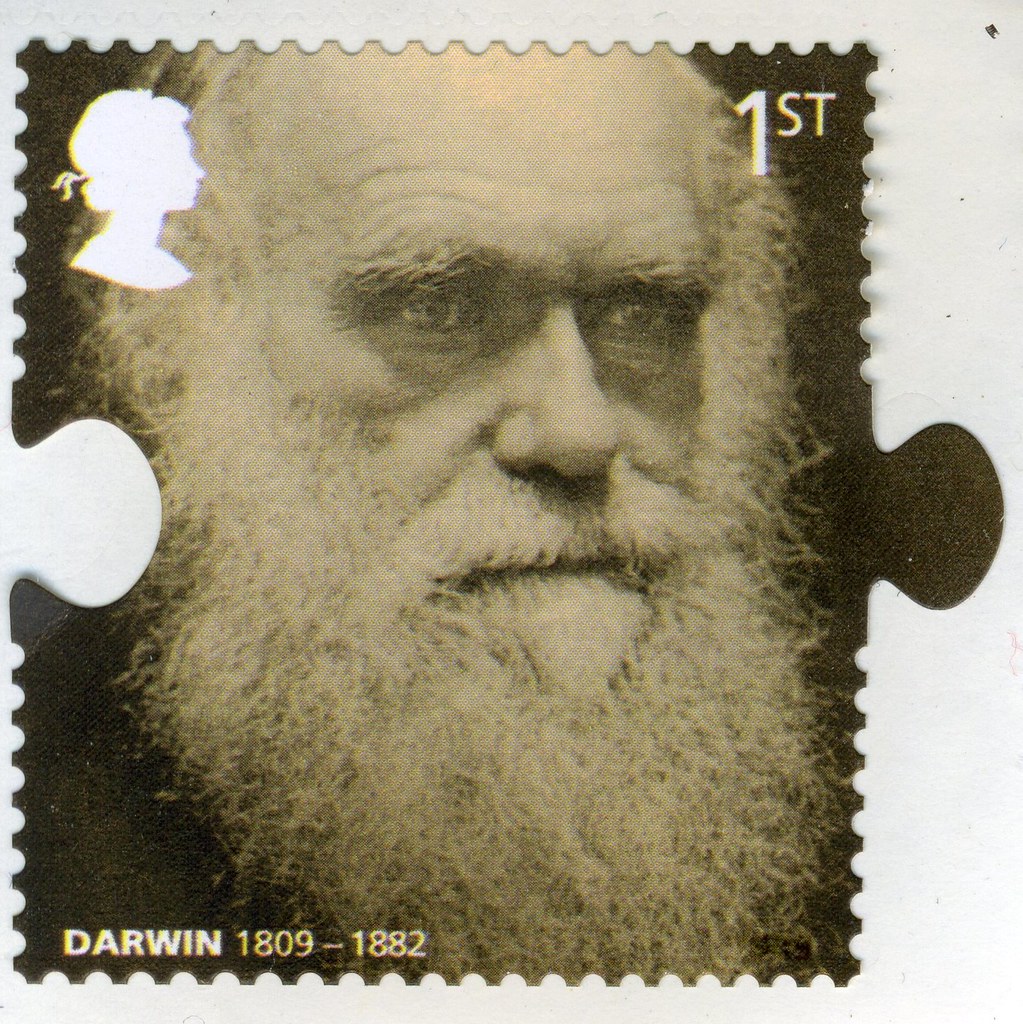
The Darwin 200


Here is the best picture of Charles I could find, and some good thought via, our friend, Al Mohler, here.
Another pic and another and another and another and another.
And, finally, a miracle!

Link of the Moment

Ryan Stander's [Potok-Grenz-Kerouac-Augustine-Norris fan] link to and text of a document on Baptist Identity, here.
Two mistaken paths imperil this precious freedom in contemporary Baptist life. Down one path go those who would shackle God’s freedom to a narrow biblical interpretation and a coercive hierarchy of authority. Down the other path walk those who would sever freedom from our membership in the body of Christ and the community’s legitimate authority, confusing the gift of God with notions of autonomy or libertarian theories. We contend that these two conceptions of freedom, while seemingly different, both define freedom as a property of human nature apart from the freedom of God in Jesus Christ and the Holy Spirit. We reject both of them as false.
Can this be read as a comment on church membership?

Wednesday, February 11, 2009

The Apostolic Church Planter

Although I did not know him, I have been thinking about Jorge Osorio’s mission plan for organizing churches with Hisapanics for Christ. Organize a group of disciples quickly and then move on. This intriguing idea/method/call sounds appropriate and was effective. But was it biblical?
I think maybe it was.
What if a church planter is not so much the "pastor" of a church as much as he is an organizer of churches, playing the role of apostle, with (almost) sole authority to organize a group of Christians in to a classical-biblical congregation [preach the gospel, administer the sacraments, practice discipline]. Where and when a church is finally "organized" an apostle moves on, leaving a pastor/elder team to lead the church and a congregational government to act in large, or "apostolic" decisions.
Isn't this what Paul, Barnabas, and the other (unmentioned?) disciples, who seem to have shortly left Jerusalem presumably to organize churches did? Moving from city to city evangelizing and gathering and then moving on. Apocryphal or not, there are no histories of specific churches where Thomas, Bartholomew or James the Less ruled from outside Jerusalem. If anything all of the apostles seemed to operate as itinerant organizers, starting churches as they went, leaving pastor-shepherds behind in their good gospel-wake.
A seminal idea at least, but I think it could be a missing piece of strategy that prevents church planting efforts from becoming church planting movements. Not being a church planter I could be way off the mark, but I would like to explore this idea further.

Tuesday, February 10, 2009

Church Membership and the Declaration of Independence

Questions about church membership confronts head-on and attempts answer a couple of important questions, one of which the Declaration of Independence also attempts to answer:

Is a human being fundamentally defined by a set of "inalienable rights" or by an endowing by their Creator?

Fortunately for America, the Declaration of Independence scrambles the two.
If you are one that leans towards rights, then you will also place less importance on church membership. Persons who have received rights that cannot be taken away are also persons who can freely choose to join (and leave) whatever church they would like, or, more correctly, whatever church will take them. Membership and participation are reduced to and defined by the assent of the member to church practice and doctrine and discipline.
If, on the other hand, you are one that leans towards endowing then you will have a higher view of the church and of membership. A person who understands that any "right" given have been granted by their Creator must ultimately give credit to and be obedient to that Creator. That person will submit to church practice, and doctrine, and when necessary, church discipline as the established Head of the church. All members of a congregation submit to one another as all submit to Christ.
In an increasingly voyeuristic-pluralistic world, the testimony that Church Membership by gifted endowment of the creator brings with it a humble recognition that the "we" of any church have not been gathered by assent but called by decree.

Friday, February 06, 2009

Good Augustinian Coffee


For when the one supreme God of gods is thought of, even by those who believe that there are other gods, and who call them by that name, and worship them as gods, their thought takes the form of an endeavour to reach the conception of a nature, than which nothing more excellent or more exalted exists. And since men are moved by different kinds of pleasures, partly by those which pertain to the bodily senses, partly by those which pertain to the intellect and soul, those of them who are in bondage to sense think that either the heavens, or what appears to be most brilliant in the heavens, or the universe itself, is God of gods: or if they try to get beyond the universe, they picture to themselves something of dazzling brightness, and think of it vaguely as infinite, or of the most beautiful form conceivable; or they represent it in the form of the human body, if they think that superior to all others. Or if they think that there is no one God supreme above the rest, but that there are many or even innumerable gods of equal rank, still these too they conceive as possessed of shape and form, according to what each man thinks the pattern of excellence. Those, on the other hand, who endeavour by an effort of the intelligence to reach a conception of God, place Him above all visible and bodily natures, and even above all intelligent and spiritual natures that are subject to change. All, however, strive emulously to exalt the excellence of God: nor could any one be found to believe that any being to whom there exists a superior is God. And so all concur in believing that God is that which excels in dignity all other objects. -Augustine, On Christian Doctrine, Book One, Chapter 7

I like my coffee strong, you might not. Which is to say that we are each motivated by different kinds of pleasures. Everybody makes their coffee up the way that they like it. One lump or two? Without Christ we can do no more than think of God in terms of the pleasures our body desires. “God” to the sinful self is no more than a good (or rather the best possible) cup of coffee. He is no more that what appears to be the best most beautiful thing. In our sinful state will always naturally exchange the glory of the immortal God for physical things resembling perishable created things. Romans 1:23 Without Christ we can only make judgment based on our own fallen pattern of excellence. But those of faith are different. The faithful, however, venture to place Christ above and outside all that is visible and physical, above all intelligent and spiritual thought which are subject to change. The Only Begotten receives authority over all things by His death. Colossians 1:16-17 Through his blood our fallen minds are renewed Colossians 1:19-22a and we begin to see Christ and God and all of life rightly. Life becomes more than just a quest for the best possible cup of coffee, but a journey in and under the One who teaches us to enjoy and savor that cup only as we enjoy and savor Him.

Thursday, February 05, 2009

Congregational Government

Twice in Matthew Jesus says these words:
Whatever you bind on earth shall be bound in heaven, and whatever you loose on earth shall be loosed in heaven. Matthew 16:19; 18:18
Interesting applications by J. Howard Yoder, here.
My two cents:
In both instances Jesus references "binding and loosing" in the context of the church [ekklesia], the only difference between the two is that one is addressed directly to Peter, "you" singular and the other, presumably is addressed to the assembled congregation, "you" plural. In other words, in one case Peter the Apostle is given heavenly authority to "bind and loose" things on earth, and in the other case that same authority is given to the church body, to the congregation.
Notice Paul the Apostle's words to the Corinthians:
Even though I am not physically present, I am with you in spirit. And I have already passed judgment on the one who did this, just as if I were present. When you are assembled in the name of our Lord Jesus and I am with you in spirit, and the power of our Lord Jesus is present... 1 Corinthians 5:3-4
Another passage on church discipline. Paul seems to be saying that although I am not, physically present, the assembled church has the same authority to make judgments that I would have if I were present. Notice also that the phrase, "our Lord Jesus is present" may allude to Christ's words in Matthew 18:20, For where two or three come together in my name, there am I with them.
Congregational government seems to take the place of apostolic authority. In the New Testament the apostles and Paul, and perhaps James rule with authority over the church, that authority is also vested in the gathered body of the church as well. Normal practice for New Testament churches, as taught by Paul at least, seems to be that what was apostolic authority now rests in the gathered whole as we assemble in Christ's name.

Thursday, December 25, 2008

We went with Blue on the Christmas Tree This Year

I still claim there are two ways to decorate a Christmas Tree. 1) The family heirloom tree, decorated with treasured ornaments from Christmases past. 2) The theme tree, decorated with a premise or color scheme. Our family generally does the latter. Themes from years past include: white lights with gold ornaments; red wooden snowflakes; a purple light tree; oversized red balls; silver and white. This year we decided on blue and white lights with blue balls and silver snowflakes picked up on K-Martclearance last year. Dad did the lights, Lincoln put the star on top and helped place balls on the tree, Liberty helped place the balls (she could reach) in the middle of the living room, and Mom correctly adjusted the ornaments.
Blue is not your traditional Christmas color, the tradition limited to red and green and maybe gold, (Gold and it’s cousin frankincense are technically Epiphany colors) leaving blue out in the cold. I did run across this in William Sandys’ 1833 book Christmas carols, Ancient and Modern. It’s the only mention of anything blue in this book of 100 carols:

The fire with well-dried logs supplied,
Went roaring up the chimney wide;
The huge hall-table's oaken face,
Scrubbed till it shone, the day to grace,
Bore then upon its massive board
No mark to part the squire and lord.
Then was brought in the lusty brawn,
By old blue-coated serving-man;
Then the grim boar's-head frowned on high,
Crested with hays and rosemary.

This carol celebrates the Boar’s Head Feast. Little did you know that this feast is probably the oldest continuing festival of the Christmas season. I knew little of the feast as well until I pulled it up on Wikipedia and found that the festival dated back to the 1300’s. Lords and servants alike, gather together to feast and tell the story of the Nativity. The height of the evening being when the dining guests watched the boar’s head marched through the hall. Oh to be present in the fire-lit hall on Christmas Eve when the blue-coated serving-man triumphantly brings in the roasted boar and everyone cheers! What a celebration!
Although we may have a Blue Christmas without you, Christmas should still be a feast. At Christmas we gather one and all to celebrate Life and Light. We experience first hand the goodness of God. His Son is given, born in a manger that we might:
Taste and see that the LORD is good! Blessed are they who takes refuge in Him.
Psalm 34:8
The Christ-Child enjoyed every meal and song and color of life, because the Son of God took refuge in His Father in Heaven in all things. We pray that God shows you His goodness this Christmas as you take refuge in Him.
May your taste and see the goodness of God the Father.
May you be blessed by every carol and meal, may you enjoy the fellowship of family and friends, and may you learn to love all the colors of Christmas.
We take refuge in the Lord, we relish in the Gift he has given, and we are thankful for all that God has in store for you and for us now and in the year to come.
To you and yours at your feast,
Caput apri defero,Reddens laudes Domino!
Benjamin & Kristl, Lincoln, Liberty

Friday, December 05, 2008

Light of the World

There are lights at Christmas for two reasons. The first is that Jesus speaks of himself as the "light of the world" because only he reveals/reflects God the Father.

There are lights at Christmas for a second reason. It is night. Christmas comes at the darkest season of the year (apologies to those of you living in Australia). Jesus is not only the light of the world but a light that shines in darkness. It is a wonder and mystery and to his eternal glory that the Father chooses to give us light at all.

John has this great comment at his recounting of Jesus' betrayal. Right after Judas leaves the last supper John says, "and it was night." The deeds done dirt cheap are done in the darkness, but the Christ then responds with his own commentary on the betrayal:
When he had gone out, Jesus said, "Now is the Son of Man glorified, and God is glorified in him. If God is glorified in him, God will also glorify him in himself, and glorify him at once.
The glory of God shines in and through the Only Begotten. He is Light. The light of the Father. The light that penetrates our darkness.

Wednesday, November 19, 2008

Everything Biblical Hebrew

Here is the best introduction to Hebrew Script that I have found: Omniglot
(more on Hebrew script than you wanted to know)

Best Learning Site: Hebrew for Christians
(a little too heavy on all the messianic Judaism stuff, but each of the twelve or so sections under Grammar is divided up into individual lessons, like 9 lessons just on nouns alone.)

A little clunky but... you can find Thirty One Hebrew Lessons here:
Biblia Hebraica

Here is Chapter-by-Chapter mp3 readings of the Hebrew Bible:
Mechon Mamre and here: Academy of Ancient Languages

Which you can listen to and follow along with these Hebrew-English rendition of the Hebrew Bible:
Mechon Mamre
Sacred-Texts

Tyler Williams, the OT / Hebrew professor at Taylor University College, Edmonton, Alberta. (my alma mater) website: Biblical-Studies.Ca Biblical-Studies Blog

Lists and links to Teaching Tools and Links can be found Here:
Hebrew Language Teachers' Toolbox and here Bible-Researcher and here is the insane list of Links for everything Hebrew PaleoJudaica

also check out the list of Hebrew Grammars etc. on Google Books
Elements of Hebrew Syntax by an Inductive Method
Gesenius' Hebrew Grammar
A Hebrew and English Lexicon of the Old Testament
The Analytical Hebrew and Chaldee Lexicon
A Lexicon, Hebrew, Chaldee, and English
A Grammar of the Hebrew Language

Old languages and old books are better!

Sunday, November 16, 2008

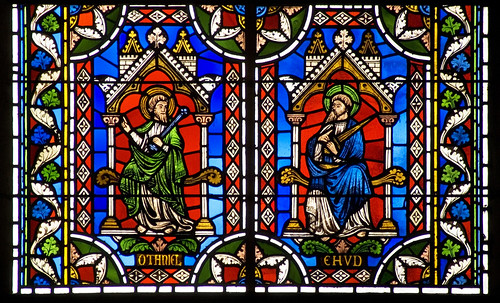
Ehud and Jesus


The story of Ehud has always fascinated me. 
ESV, Judges 3:15-26
The people of Israel cried out to the LORD, and the LORD raised up for them a deliverer, Ehud, the son of Gera, the Benjaminite, a left-handed man. The people of Israel sent tribute by him to Eglon the king of Moab. And Ehud made for himself a sword with two edges, a cubit in length, and he bound it on his right thigh under his clothes. And he presented the tribute to Eglon king of Moab. Now Eglon was a very fat man. And when Ehud had finished presenting the tribute, he sent away the people who carried the tribute. But he himself turned back at the idols near Gilgal and said, "I have a secret message for you, O king." And he commanded, "Silence." And all his attendants went out from his presence. And Ehud came to him as he was sitting alone in his cool roof chamber. And Ehud said, "I have a message from God for you." And he arose from his seat. And Ehud reached with his left hand, took the sword from his right thigh, and thrust it into his belly. And the hilt also went in after the blade, and the fat closed over the blade, for he did not pull the sword out of his belly; and the dung came out. Then Ehud went out into the porch and closed the doors of the roof chamber behind him and locked them. When he had gone, the servants came, and when they saw that the doors of the roof chamber were locked, they thought, "Surely he is relieving himself in the closet of the cool chamber." And they waited till they were embarrassed. But when he still did not open the doors of the roof chamber, they took the key and opened them, and there lay their lord dead on the floor. Ehud escaped while they delayed, and he passed beyond the idols and escaped to Seirah.
When Luke comments on Jesus "Beginning with Moses and the Prophets, he interpreted to them in all the Scriptures the things concerning himself." Or when Matthew says that Jesus "Do not think that I have come to abolish the Law or the Prophets; I have not come to abolish them but to fulfill them."
How are Ehud and Jesus related?
Is all Scripture a testimony to Christ, who is Himself the focus of divine revelation or are there parts of  Scripture that do not rise to the full level of Christ.? I would like to confirm the latter, but Ehud and the mildew laws and the strange story of Noah getting drunk or of Rehoboam's claim, all tend to push the envelope of being a "testimony to Christ".

Thursday, October 30, 2008

Baptism

A fellow pastor had made mention in passing that the book of Acts contains examples of people being saved with out being baptized. Curious, when I checked it out all I could find were general descriptions such as:
17: 12 "Many of the Jews believed, as did also a number of prominent Greek women and many Greek men."
14:1 "There they spoke so effectively that a great number of Jews and Gentiles believed."
However _every_ conversion of an individual is _always_ accompanied by a baptism.
  • Acts 1 "John's Baptism" v. "Spirit's Baptism"
  • Acts 2 The Crowd at Pentecost
  • Acts 8 Simon the Sorcerer
  • Acts 8 The Ethiopian Eunuch
  • Acts 9 (& Acts 22) Saul
  • Acts 10 Cornelius
  • Acts 16 Lydia
  • Acts 16 Philippian Jailer & Family
  • Acts 18 Crispus
  • Acts 19 Apollos
  • Acts 19 The Disciples of Ephesus
Even if I have overlooked something (which is likely) the overwhelming evidence seems to point toward baptism being the normal apostolic practice. 
Question: If the evidence from the book of Acts points toward baptism being a normative first response to the converting work of the Holy Spirit, what the Biblical grounds for conversion and baptism to be separated, as is our normative practice today?
Something to chew on.

Saturday, August 30, 2008

Assurance

The real Christian, enjoying assurance of salvation, has holy boldness but he also has less of self-confidence and more modesty...He is less apt than others to be shaken in faith, but more apt than others to be moved with solemn warnings, and with God's frowns, and with the calamities of others. He has the firmest comfort, but the softest heart. Richer than others, he is the poorest of all in spirit: the tallest and strongest saint, but the least and tenderest child among them.


What is it that Jonathan Edwards knows about knowing Christ? I would much rather leave the messy task of sorting out the good fish from the bad to Christ. At the end of the day there will be those who, though they say they are, ain't, and those who don't know, who are. Assurance should never rely on any date written in your Bible or statements from another Christian. But assurance stems from a careful examination with fear and trembling of evidences of grace in our life.

Yet, too often, we give less thought to these matters than we do to doing the dishes or feeding the cat. I want to be a real Christian. I want to be moved by the word of God. To find that treasure in the field and then to sell all in my joy.

No, it is not owing to God, nor to any of his revelations, that true saints ever doubt of their state; his revelations are plain and clear, and his rules sufficient for men to determine their own condition by. But, for the most part, it is owing to their own sloth, and giving way to their sinful dispositions. Must God’s institutions and revelations be answerable for all the perplexities men bring on themselves, through their own negligence and unwatchfulness? It is wisely ordered that the saints should escape perplexity in no other way than that of great strictness, diligence, and maintaining the lively, laborious, and self-denying exercises of religion.

Sunday, March 30, 2008

Islam and Catholicism

Reuters reports that the Catholic church is conceding their number on seed to Islam.
Monsignor Vittorio Formenti, who compiled the Vatican's newly-released 2008 yearbook of statistics, said Muslims made up 19.2 percent of the world's population and Catholics 17.4 percent.

This news may get evangelicals talking and may cause concern, but will it result in a change in mission strategy or focus? Will it open up dialogue?

Sunday, October 21, 2007

Who Is Tom Hanks

Was flipping through old wall posts and noticed
Q: Not a Tom Hanks fan, then??
A: I always liked the everyman.

My question for Tom, if I could superpoke at his soul, what message (gospel?) do you follow.

I wonder why the ending of Castaway , the ending of Saving Private Ryan, seem to state/preach of life as randomness and without meaning (ala, Huxley's A Brave New World)

What do Apollo 13, Catch Me If You Can, That Thing You Do, Joe Versus the Volcano mean if not life is mostly just kind of there? Did I mention Forrest Forrest Gump? There's an everyman movie if there ever was one, but the message? Schtuff Happens... Have a Nice Day.

P.S. You thought I was going to say, "Life is like a box of chocolates..."

Friday, October 19, 2007

Hillary on Faith (sent)

I am very grateful that I had a grounding in faith that gave me the
courage and the strength to do what I thought was right,
<i>regardless of what the world thought</i>.

Friday, October 05, 2007

Grandmothers


It's grandparents day at my son's school today. They will be putting on a cute program I am sure. But now, the New York Times Well blog, Tara Parker gives us this, "Are grandmothers an evolutionary necessity?" The blogpost highlights the evolutionary anomaly that human females live well beyond their reproductive years, and contribute significantly to their societies rather than being a burden. Researchers are proposing that work performed by grandmothers while younger women are caring for infants acts as a significant balancing factor for societies and human evolution as a whole.
Contrast this with what the Church has taught the value of older women since the time of St. Paul.
Don't be harsh or impatient with an older man. Talk to him as you would your own father, and to the younger men as your brothers. Reverently honor an older woman as you would your mother, and the younger women as sisters.
Take care of widows who are destitute. If a widow has family members to take care of her, let them learn that religion begins at their own doorstep and that they should pay back with gratitude some of what they have received. This pleases God immensely. You can tell a legitimate widow by the way she has put all her hope in God, praying to him constantly for the needs of others as well as her own. But a widow who exploits people's emotions and pocketbooks—well, there's nothing to her. Tell these things to the people so that they will do the right thing in their extended family. Anyone who neglects to care for family members in need repudiates the faith. That's worse than refusing to believe in the first place.
1 Timothy 5:1-8, the Message
Although the theories are speculative but interesting, we should value our grandmothers for more reasons than their ability to allow the gene pool to advance.
  • Grandmothers have value beyond what they contribute economically, genetically, or socially. They have a long history of spiritual formation of their grandchildren.
  • Grandmothers (persons) have worth just for the simple fact that God chosen to created them and never for what they contribute.
  • While the grandmother in an evolutionary world view may be only of worth in how she contributes to the survival of her offspring, the Bible gives all person an innate value to God, who does not anyone's "line" to die out. This grandmother hypothesis may explain why humans were able to "take over the planet" but it fails to account for the often selfless, sacrificial, overflowing desire for humans and most often grandmothers to give of themselves for the sake of another.

    Friday, August 10, 2007

    Wesley Quote


    Catch on fire with enthusiasm and people will come for miles to watch you burn.

    This is usually attributed to John Wesley, however Wesley also writes this:
    As to the nature of enthusiasm, it is ,undoubtedly a disorder of the mind; and such a disorder as greatly hinders the exercise of reason. Nay, sometimes it wholly sets it aside: it not only dims but shuts the eyes of the understanding. It may, therefore, well be accounted a species of madness; of madness rather than of folly: seeing a fool is properly one who draws wrong conclusions from right premisses; whereas a madman draws right conclusions, but from wrong premisses. And so does an enthusiast suppose his premisses true, and his conclusions would necessarily follow. But here lies his mistake: his premisses are false. He imagines himself to be what he is not: and therefore, setting out wrong, the farther he goes, the more he wanders out of the way.
    and
    Beware you are not a fiery, persecuting enthusiast... Never dream of forcing men into the ways of God. Think yourself, and let think. Use no constraint in matters of religion. Even those who are farthest out of the way never compel to come in by any other means than reason, truth, and love.
    Sermon 37, The Nature of Enthusiasm, 1872

    My guess is he never said that enthusiasm was anything worthy of the Christian. Preferring reason, truth and love to reconcile persons to God.

    Friday, August 03, 2007

    A Prayer for Friday

    You, O Lord, are truly the pure and eternal source of goodness.
    You have justly turned your face from us, and in loving-kindness you have had mercy upon us.
    You hated and reconciled;
    You have cursed, and have blessed;
    We have been banished from Paradise by You, and you have remembered us;
    You strip off our shoddy fig-leaves, and clothe us with a costly garment;
    You have opened the prison doors and have released the condemned;
    You have sprinkled us with clean water, and washed away our filthiness.
    No longer will Adam hide from You when called, convicted by conscience, cowering in the brush.
    No longer will the flaming sword flash before Paradise, making entrance inaccessible when we draw near;
    All has been turned to joy for we who were once the heirs of sin:
    Man can walk into Paradise and Heaven:
    Creation, world below and world above, once separated from itself, has been knit together in friendship:
    Man is made to join with the angels’ song, offering praise in worship to their God.
    For all these things, let us sing for joy to God
    Let us sing with lips touched by the Spirit long ago.
    Let my soul be joyful in the Lord: for He has clothed me with a garment of salvation, and hath put upon me a robe of gladness: as on a bridegroom He hath set a mitre upon me, and as a bride hath He adorned me with fair array-Isaiah 61:10
    The One who adorns the bride with splendor is Christ, Who is, and was, and shall be, blessed now and for evermore. Amen.

    -Gregory of Nyssa (c. 335-c.394)
    On the Baptism of Christ

    Thursday, July 19, 2007

    Eternal Life

    I'm listening to Chuck Swindoll today. Good message on Death. (It has an English accent when spoken aloud.)
    Always excellent teaching but today I couldn't get past this one thing. In his message he repeated this oft-repeated Evangelicalism:
    There is a sense in which everybody has eternal life because everybody is going to spend eternity somewhere. Those who have accepted Jesus Christ will spend eternity in Heaven and those who have not accepted Him are going to spend eternity in Hell.

    But John 3:16 (also an oft-repeated Evangelicalism) indicates that eternal life, zoe aionios, is something in God through the Son that we have. We don't have eternal life and then we gain eternal life through believing in the Son. In fact John goes on to day that those who don't believe live in death.
    I tell you the truth, whoever hears my word and believes him who sent me has eternal life and will not be condemned; he has crossed over from death to life. I tell you the truth, a time is coming and has now come when the dead will hear the voice of the Son of God and those who hear will live. For as the Father has life in himself, so he has granted the Son to have life in himself. -Jesus the Christ, John 5:24-26

    Where do we go with this?

    • In what sense is it "eternal life" for those in Hell?
    • Is it the fact that it is LIFE or that it is ETERNAL matter more?
    • Does the "crossing over from death to life" have a present sense? How?

    Maybe we should stop quickly repeating things we hear on the radio.

    America


    Does this say two things at once? I think this says two things at once.
    What exactly will destroy America?

    Friday, July 06, 2007

    Preaching in a Dry World

    There is a saying in Japan, the nail that sticks out will be hammered down. In America we value independence and freedom. We celebrate it every Fourth of July, but sellers of satisfaction claim that independence and freedom can be, must be, bought and sold. Someone must pay a price. We are told when we purchase the right product we free ourselves. Against this culture the Church undergoes great risk in their proclamation. We proclaim a price has been paid. We proclaim that paying any other price, buying and selling anything for independence does not bring freedom but bondage. It is a risk to be noticed and stick out in a dry world that insists on a price being paid for freedom. It is a risk but this is what attracts God's mercy and forgiveness. Chaos can result when we proclaim no other way but God's the more obvious the dryness, perhaps only in dryness, the more God's freedom satiates.

    Friday, June 15, 2007

    Becoming the Kind of Person who Reads

    I once read a quote from Stanley Hauerwas that his job as theologian involved reading for three hours a day. That is attractive.

    Rich and Poor


    The rich are different than you and me.
    -F. Scott Fitzgerald

    There's only one thing left to do: Sell everything you own and give it away to the poor. You will have riches in heaven. Then come, follow me.
    -Jesus of Nazareth

    How much do we talk-complain-pay attention to the rich? How much did Jesus pay attention to the poor? Granted he walked in the circles of the elite as well (Nicodemus, Synagoge Rulers, Centurions, etc.), and his conversations with them were just as "other-worldly" as they were with the poor. But to the poor he offered something tangible. A healing touch, a compassionate word, freedom from bondage, forgiveness. The rich? It always seemed just beyond their reach, a reflection perhaps.

    In reply Jesus declared, "I tell you the truth, no one can see the kingdom of God unless he is born again-born from above."
    -Jesus of Nazareth

    Wednesday, May 30, 2007

    Jubilee


    Right there in the middle of the movie Glory is a great biblical reference.
    That's right, Hines. Ain't no dream. We runaway slaves but we come back fightin' men. Go tell your folks how kingdom come in the year of jubilee!

    In the Old Testament, year of jubilee was a year of liberation: of servants, property, the land, debts and crops. All property sold as payment to relieve poverty, was to be returned to the original owners without restoration of the original amount advanced. The Old Testament describes the land as God's inheritance, given to all Israel
    The land cannot be sold permanently because the land is mine and you are foreigners—you're my tenants. You must provide for the right of redemption for any of the land that you own. Leviticus 25); See also Ezekiel 33
    In the New Testament, Jesus extends the jubilee by proclaiming a year of good news to the poor, release for captives, sight to the blind, and liberation to the oppressed. He taught his disciples to pray for the forgiveness of debts (as we forgive our debtors). Pentecost was characterized by the voluntary sharing of possessions, so that there was not a needy person among them. Acts 3:34, cf. Deuteronomy 15:40
    Christian disciples of the American South understood freedom in this way. Freedom granted by God as an establishment of His kingdom. Freedom has always been a key element in the Kingdom of God. Christian men and women are free to serve because they are holy and set apart; they are not bound to the kingdom of this world. They are bound together, spiritually and courageously, to the One who has granted their freedom.
    Good morning gentlemen, I am Colonel Robert Gould Shaw. I am your commanding officer. It is a great pleasure to see you all here today. It is my hope that the same courage, spirit, and honor, which has brought us together, will one day restore this Union. May God bless us all.

    Friday, May 25, 2007

    The Russians

    Was 9/11 the last uniting event in America or just the latest?
    I don't watch The Daily Show with John Stewart, meaning I don't make it a point to watch it, but I was flipping channels yesterday and came across this quote...
    I gotta tell you, over the last few months as we've seen Russia commit political assassinations, suppress its media, and rig elections, I can't help but think, "They're back baby." Do you think they'd want to get in the cold war with us , because that war was awesome, so much better than this one. You know, I remember when we were at war with Russia for like 50 years, and what was the worst thing that happened? We ended up missing an Olympics... I tell you, having Russia as our enemy again, I would totally trade [Osama Bin Laden] for [Yakov Smirnov]. What a country indeed.
    Full clip here.
    Does America need an "enemy" to bring us together? The Cold War, the "War on Terror", the "War on Poverty", Vietnam... If Americans believe that Governments are instituted among Men to secure rights then it is their right, it is their duty, to throw off oppressive Government, and to provide new Guards for their future security. Maybe because we are a nation that was formed by "throwing off," we are constantly on the look out for new Oppressors. The great Russian authors seem to see it differently. War does not hinder death and oppression, only love can do that.
    Love? What is love? . . . Love hinders death. Love is life. All, everything that I understand, I understand only because I love. Everything is, everything exists, only because I love. Everything is united by it alone. Love is God, and to die means that I, a particle of love, shall return to the general and eternal source. —Leo Tolstoy
    God is love. Love may be all a man might need to know.

    Friday, May 11, 2007

    Uncaptive Mission


    Is it safe to go out today? The crosses on the outside of our church sould shout, "No!" No, it is not safe "out there" in the world. The travellers on the Emmaus road make this abundantly clear.
    Jesus' response to trouble is also clear. "So thick headed!" And Jesus goes on to explain life and scripture and how all things make sense because of him. I love how Eugene Peterson puts it, It's in Christ we find out who we are and what we are living for.
    Those who know who they are,
    Who know who they're living for
    Who know why they are alive!
    They are the ones that go.

    Thursday, April 26, 2007

    Leading from the Inside


    Do we really need leaders? Do we need Christians to walk at a faster pace than the rest? To run to the front? The great missions movements of the 19th century began with shoemaker/botanist/baptist/missionary William Carey's, "Expect great things; attempt great things." Carey used this phrase in a 1792 sermon to urge his Baptist colleagues to enter the missionary enterprise. Many other movements withing Christendom have followed suit. Run to the front lines and see if God will meet you there. What he did not say was "Expect great things for God; attempt great things for God." Maybe I should take a second look at William Carey.

    At the end of last year Wesley Autry jumped off a train platform to save a stranger who had fallen on to the tracks. This heroic act has been turned in to a good salvation metaphor. I like it. Christ jumps off the tracks, runs to the battle, walks deliberately toward the cross--all to save us.

    But the logic is flawed. I agree with the thought that "we must do more to reach lost people for Christ." In and of itself you can't argue with working everyday, every moment toward a life that gives all for the Lord so that never an opportunity is lost to share and witness and help other to encounter the Risen One. But... for William Carey, he was so focused, so far out in front, so "into" his goal that many were appalled at the neglect with which Carey looked after his four boys and his wife. Carey simply ignored them. Is it possible to want to "reach lost people for Christ" to the point that we ignore those who have fallen on to the tracks around us?

    This is where the story of William Carey and Wesley Autry intersect. Maybe William Carey's dream of a mission to India became an idol? Maybe running to the front is not the example Christians leaders are to portray. "I'm still saying I'm not a hero ... 'cause I believe all New Yorkers should get into that type of mode," Wesley Autry said on CBS' The Early Show. "You should do the right thing...I was like, 'Maybe I was in the right place at the right time, and a good thing happened for good people.'" A leader is not a heroic explorer, because a leader wants everyone to get into the type of mode their in. And if they are in the right type of mode then they can say follow me as I follow Christ.

    Godly leaders don't always need to run to the front. Maybe a godly leader is always in the right place. For godly leaders maybe it is always the right time. I believe a godly leader will be driven, not by something outside themselves, visible in time and place, but by a fire in our heart that can't be held back no matter how hard we try. Our passion, our dream, our fire should not be "ours" alone.

    From another Wesley...
    Catch on fire with enthusiasm and people will come for miles to watch you burn.
    John Wesley

    Keep jumping

    Friday, April 13, 2007

    Easter Sunday

    During Holy Week I had the privilege of burying a Christian man with a strong witness to the steady hand of God. It was very appropriate that during the week on which we buried him we as Christians were looking forward to the celebration of the resurrection the following Sunday.

    Jesus of Nazareth lives outwardly, a life that looks beyond himself toward the needs of others. "He came to love, heal, and forgive" is how the Gaither's describe it. But the mission Christ the Messiah was always an other-worldly focus. He was passionate and committed to doing His Father's will and only his fathers will. Good Friday's "not my will, but yours, be done." Luke 22:42 reminds us of this.

    Praise God that His mission is to create for himself a people, not just persons. And Praise God that Christ was willing to form that people by his own body and blood.

    "When we embrace faith—when God embraces us—we become new creatures constituted and called to be part of the people of God. We are invited into the story of God's engagement with humanity"—Miroslav Volf

    One half of God's mission involves calling a people to himself. When we heal, love and forgive we take part in this half. But the second half of God's mission involves centering that people, establishing that people, "constituting" that people in and around Himself. When we risk, when we give, when we ask for forgiveness, when we fall on our knees before God and say "not my will, but yours, be done." We take part in the second half.

    The "Free Hugs" campaign is a nice idea, but it seem a little ways off from a faith that both embraces and is embraced by God.

    Thursday, March 08, 2007

    Beauty

    In his reply to Faustus the Manichaen, St. Augustine writes...
    the Church is for the glory of Christ, that her beauty may bring honor to her husband

  • Full Quote Here

  • The ways in which a church can be beautiful are then, supposedly as many as the ways in which a woman is beautiful. Or as a friend (I think it was Perry Mayforth) from college once put it, "Every woman is beautiful, but as I get to know her she then becomes more or less beautiful."

    From Zion, perfect in beauty,
    God shines forth.
  • Psalm 50:2
  • Monday, October 30, 2006

    A Humility Challenge


    I leant my copy of C.J. Mahaney's book Humilty out a few months ago, and it has been late in coming back. I always appreciated how Mahaney makes the Christian life doable. But I doubt he has a chapter in his book on how to be humbly-demanding. How do you ask for a book on humility back, with out coming accross as superior or demeaning? A conundurm.

    Wednesday, October 25, 2006

    Questions without answers


    In working on my ordination paper, I continue to come up with questions that I have not been able to answer. Here are the top three for the moment:

    1. Why create angels/fantastic beings/ministering spirits at all? If the pupose of an angel is only to glorify God then why does an angel need a will independent of God?
    2. Does Satan fall to a physical, meta-phyiscal or a spiritual place? What about time? When did Satan fall, in our time or beyond our time, i.e. before or after "in the beginning"?
    3. Because God does not have hands like we do, or a mouth or a voice like we do, do we not misrepresent God when we say that he "speaks the world into being?" Isn't "and God said let there be light..." just as symbolic as "with the breadth of his hand marked off the heavens?"

    Some thoughts.

    Thursday, September 21, 2006

    The Poor

    Had a discussion on Sunday that I have been mulling over for the week. During our Sunday Evening Bible Study we read through Jesus' choice of about himself in Luke 4. Out of all of the Old Testament, Christ chooses this passage of scripture to refer to himself:
    The Spirit of the Lord is upon me, because he has anointed me to proclaim good news to the poor. He has sent me to proclaim liberty to the captives and recovering of sight to the blind, to set at liberty those who are oppressed, to proclaim the year of the Lord's favor. Luke 4:18-19, ESV

    My purpose was to show that the ministry of Jesus was to be to both the Jews and Gentiles, but a good question was asked which sidetracked us from my intent: "Why didn't Jesus just say that he has come to bring good news to everyone?"
    My response was, "Because Jesus came for the poor, not the rich."
    "Poor in spirit." "Does Jesus mean something else by the word poor?" Were the replies. One person even quoted proverbs about the value of hard work.
    Why does money cause such difficulty?
    There is nothing inheritly spiritual about "being poor." And it is safe to say that there is nothing inheritly spiritual about "being rich."
    Then, today I had the priviledge to attend the Chapel service during Trinity Evangelical Divinity School's "Global Christian Week."

    Steve Haas, Vice President of Church Relations at World Vision, spoke and said something to the effect of... "the poor are treated as inhuman, less than human, and Jesus enters into their lives to love them and treat them as humans created in the image of God."
    Jesus comes to proclaim the year of the Lord's favor, the year of God's willingness to treat us a his beloved. He releases captives from their prisons because of his desire to show us that he is love. He brings the poor up form their low estate.

    The rich have no need to be humanized, they already have their power.

    Thursday, September 14, 2006

    OED - Industrious

    The OED Oxford English Dictionary, had Industrious as its "word of the day" today.

    Industrious has moved from sense one:

    1. Characterized by or showing intelligent or skillful work; skillful, able, clever, ingenious. (Of agents, their actions, etc.). Obs.

    to sense four:

    4. Characterized by or showing assiduous and steady work; full of work; diligent, laborious, hard-working. (The prevailing sense.)

    A world of assiduous and laborious people does not create beauty.

    Best Compliment

    My son Lincoln spent the night with three other boys at friend's Birthday party / Sleep over on Saturday night. So in church the next morning our friends filled up the back row with the three extra boys they had with them. Midway through the service one of the boys turns to another and makes this comment, "You guys talk about God a lot more than we do at our church."

    Best compliment I've had in a while.

    Sunday, September 03, 2006

    Listening


    I spoke on Proverbs 18 today, focusing on verse 13, "If one gives an answer before he hears, it is his folly and shame."
    In preparation I came across this from Dietrich Bonhoeffer:

    The first service that one owes to others in the fellowship consists in listening to them. Just as love to God begins with listening to His Word, so the beginning of love for the brethren is learning to listen to them. It is God's love for us that He not only gives us His Word but also lends us His ear. So it is His work that we do for our brother when we learn to listen to him. Christians, especially ministers, so often think they must always contribute something when they are in the company of others, that this is the one service they have to render. They forget that listening can be a greater service than speaking.
    Many people are looking for an ear that will listen. They do not find it among Christians, because these Christians are talking where they should be listening.
    If we are the Body of Christ as St. Paul, and Casting Crowns both say we are, then shouldn't we be paying attention to what God is up to in the lives of those we are speaking with? And how can they hear what God is up to without someone preaching? And how can we gain an audience if we won't at the very least listen to them?

    More on Bonhoeffer at:
    http://speakingoffaith.publicradio.org/programs/bonhoeffer/particulars.shtml

    Thursday, August 31, 2006

    Fill the Earth


    Christians need to be clear on which side they stand in the battle between Rugged Individualism and Blessing. Our tendency to praise the Bill of Rights / Informed-Consent / Army of One / Choice breaks any possibility of their being real community in the Body of Christ, and any possibility of restoration of the soul.

    The MSNBC.com—Washington Post article for Thursday:

    Medical practices blend health and faith
    Doctors, patients shun care they consider immoral

    The article focuses on the Tepeyac Family Center, a doctor's office in Fairfax, Virginia [just five hours from MSNBC TV on a good day]. The center news is deemed news-worthy because of their mission statement:

    The restoration of the integration of the human person by combining the best of modern medicine with the healing presence of Jesus Christ. All people are welcome here.
    "Surprisingly" the staff prays each day before the first appointments, they shun birth-control, and promote natural family planning. Essentially they are a group of doctors and staff that practice medicine and their Roman Catholic beliefs. But you can't do that in America, because in America individual choice and its cohort informed-consent rule. Any alternative is damaging to the economy. The article puts the choice / consent issue this way:

    "It's not enough for someone to advertise 'We provide natural family planning' or have a sign up in the waiting room that says 'Only natural family planning available here,' " said Jeffrey L. Ecker, an obstetrician-gynecologist at Harvard Medical School."The assumption shouldn't be that patients understand exactly what that means. The doctor has an obligation to fully explain all options to their patients."
    And

    "Welcome to the era of balkanized medicine," said R. Alta Charo, a bioethicist at the University of Wisconsin at Madison. "We've had this for years with religious hospitals. What's happening now is it's drifting down to the level of individual practitioners and small group practices. It essentially creates a parallel world of medicine."
    To be fair MSNBC does a fair and I think balanced view of the issues. They do get to the heart of the matter with this one quote:

    "I've encountered a lot of resistance to how I practice over the years," said Lorna L. Cvetkovich, an obstetrician-gynecologist in Ann Arbor, Mich. "For one thing, contraception and sterilizations bring in a lot of revenue. But I finally found partners who feel the way I do, and we're scraping by."
    The issue is money. The issue is not that people are operating in "a parallel world of medicine." Oriental medical practices, Homeopathic practices, and even Scientology (until recently) have been accepted for years.
    The issue is money. The issue is not informed consent or that "the doctor has an obligation to fully explain all options to their patients", or it is not as Elizabeth Dotts, 25, of Birmingham puts it in the article:

    "It caught me completely off guard, ...I felt like he was judging me and putting pressure on me... I am the patient. I am the client. It should have been about me‚ What I needed. Not what he needed or believed."
    In America judging and pressure are only good when they purchase TV time, radio spots and newspaper ads. The US Government has spent $1.4 billion on its anti-drug advertising campaign over the last 8 years. But this does not appear to have helped reduce drug use and instead might have convinced some youths that taking illegal drugs is normal. (USAToday)Do doctors really believe that every patient, given enough information, will be able to choose the right medicines, understand the correct course of treatment, and make the appropriate lifestyle changes? Have we all become little-experts on ourselves? John Calvin, 55, of Geneva would say, "uh... no." Calvin, on Genesis 1

    Since the image of God had been destroyed in us by the fall, we may judge from its restoration what it originally had been. Paul says that we are transformed into the image of God by the gospel. And, according to him, spiritual regeneration is nothing else than the restoration of the same image. (Colossians 3:10, and Ephesians 4:23.) ...But now, although some obscure lineaments of that image are found remaining in us; yet are they so vitiated and maimed, that they may truly be said to be destroyed. For besides the deformity which everywhere appears unsightly, this evil also is added, that no part is free from the infection of sin.
    I am not a Credit Card, Social Security Number, or individual in a system. I am maimed and vitiated, yes, but am being transformed into the image of God by the gospel. God blesses humanity in community, "male and female he blessed them." Then God commands the community to take God's image and "be fruitful and multiply and fill the earth and subdue it and have dominion over... every living thing that moves on the earth."
    This is good news. God sends Abraham's community into the world to be a blessing, "In you all the families of the earth shall be blessed... And Abram took Sarai his wife, and Lot his brother's son, and all their possessions that they had gathered, and the people that they had acquired in Haran, and they set out to go to the land of Canaan." (Genesis 12). This is good news. And the Church is sent into the world to be a blessing,

    "The God and Father of our Lord Jesus Christ,... has blessed us in Christ with every spiritual blessing... and seated Him at His right hand in the heavenly places,... far above all rule and authority and power and dominion... and he put all things under his feet and gave him as head over all things to the church, which is his body, the fullness of him who fills all in all." Ephesians 1. I know the Ephesians quote leaves out quite a bit in the middle, but it is one, long, run-on sentence in the Greek. The blessings of God, Ephesians 1:3-6, are linked very closely with the "filling" ministry of the Church, Ephesians 1:22-23.
    The practices of the Church, continue the filling, multiplying, dominion-ing activity of created humanity. Breaking the human community in to a loose-leaf binder of individuals shatters any possibility of blessing.

    "I want to practice my faith," said John T. Bruchalski, the obstetrician-gynecologist who started Tepeyac. "I'm not interested in pushing it on other people. But this allows me to practice medicine without having to do something that I wouldn't see as positive or healthy... We approach the person from a very holistic perspective—body, soul and spirit. We tell patients you have to take care of your body. You have to be able to communicate and develop a relationship. You have to meditate and pray to God or a higher power. We bring this to people of all backgrounds."
    Fill the earth doctor. Fill the earth.

    Sunday, August 27, 2006

    What is the Gospel?

    What is the Gospel?

    If John Piper is to be believed then God is the Gospel. In our Sunday night bible study I have been exploring the question of what the gospel is, using Piper's book as a guide. Piper begins with God as the originator of the Gospel and then unites the ideas of Gospel and Kingdom of God. Simple but rich.

    In uniting Gospel and Kingdom, Piper brings up Romans 10:9, which we looked at in more depth this evening. If you confess with your mouth that Jesus is Lord and believe in your heart that God raised him from the dead, you will be saved. Long a favorite proof of the power of the "sinners prayer" in many "gospel" tracts.

    What is obvious from the rest of the passage is that Romans 10:9 is by no means a proof of anything but the powerful inbreaking of God's kingdom into the world. What I "discovered" is the beautiful way that Paul links the confession in Romans 10:9 with Isaiah 53:

    Isaiah 53:7a "How beautiful upon the mountains, are the feet of him who brings good news." Is quoted by Paul in Romans 10:15.

    But the rest of Isaiah 53:7, "Who publishes peace, who brings good news of happiness, who publishes salvation, who says to Zion, 'Your God reigns.'" Is most definitely alluded to when Paul says, "Jesus is Lord." Jesus is the Son of God who reigns over the kings of the earth, which Isaiah 53 states v. 10 The LORD has bared his holy arm before the eyes of all the nations, and all the ends of the earth shall see the salvation of our God... v. 15 so shall he sprinkle (prosper) many nations; kings shall shut their mouths because of him; for that which has not been told them they see, and that which they have not heard they understand. (Again with allusions to Romans 10:14-18)

    Not to put N.T. Wright and John Piper in the same blog post, but N.T. Wright explains that "when Paul talks about “if you confess with your lips that Jesus is Lord,” one of the things he means, of course, is that means confessing that Caesar is not lord and that there are other lords which have ruled over you. And so the step of faith is also by the, necessarily a step of commitment, which is a commitment of life to live in a different way, to live by a different rule." Dick Staub: DS Interview - Bishop N.T. Wright: Gospel for Everyone!

    The different way, different rule of the kingdom... shows up in the ministry of Jesus. "The kingdom of God is near. Repent and believe the good news!" We repent and live by the different way, because the kingdom has been brought near, because Jesus is Lord. Stepping into the Kingdom by faith implies a silencing of the other kings in our hearts, or to use other Pauline imagery, a "putting to death." Romans 8:13-17

    Too often I believe in my heart that I enter the Kingdom of God by my repentance, by my confession that "Jesus is Lord." But by my repentance or by my mental assent to the position of Jesus as Lord will not gain me entrance into the Kingdom of God.

    Entrance into the Kingdom of God is because Jesus is its Lord and I experience his love, healing, and grace. I love the Gaither's "He came to love, heal and forgive." And in experiencing divine love, divine healing and divine forgiveness, I repent, I turn away from the kingdom of this world and it becomes the Kingdom of our God and of His Christ.

    Monday, August 21, 2006

    Leadership Emergence

    Leadership Emergence Theory was developed by J. Robert Clinton after his studying of the biographies of 1,000s of Christians Leaders in various venues and times. Clinton's conlusions being that God works in similar ways in the developing of a Christian into Christian leader, most going through a process of Character formation, Skill formation and Strategic formation. L.E.T. involves a heavy dose of "life mapping" where clues and hints can be discovered about the ways in which God's workmanship has been shaped over the course of a lifetime. "Critical incidents" positive and negative become a prime focus during the life mapping process.

    In a formula Leadership Emergence Theory reads like this:

    Leadership = Function of (p,t,r)

    Leadership is a function of p [process items], t [time], and r [our responses]. Are these really the components of leadership development / discipleship? Or is there something else?

    Saturday, August 19, 2006

    Turner County Fair


    The Four Best Days of Summer, or so the tagline goes for the Turner County fair. Kristl, Lincoln and I spent Five evenings at the fair this week, along with thousands of others. The fair draws us back night after night. I don't know if its the $4.00 indian tacos, the NC+ seed-corn booth, the open class produce entries, or the Alpacas at "Old McDonald's Farm."

    I feel like I understand "on earth as it is in heaven." Not to say that a $4.00 indian taco is heaven but...

    Sunday, August 13, 2006

    Job of Uz


    What I find most amazing about the Job story is that its internal discussion is framed by the story of the Lord's action. Job's worldview is tied very closely to what God is doing in Job's world. The Lord gives. The Lord takes. The Lord allows the roaming accuser to influence his decisions. The Lord says "brace yourself!"

    Who are we? We are God's people who are blessed and cursed by God.
    Where do we live? We live in a world that is evil and random but where every event, for good or for ill, is overseen by the Lord.
    So what's wrong? Even the most righteous man of all the east is given over to terrible tradgedy and pain.
    What's the solution? We must trust that the God of heaven does see and hear us when we cry, even though we may never know, understand, or experience relief.
    What time is it? We live inbetween when God has acted and will act again. We live in anticipation of the salvation that comes from no one else.